

The Phase Change
Money, Work, and Consciousness at the End of the Old World
There is a moment in physics when matter stops being one thing and becomes another. Water doesn’t gradually become steam. It absorbs heat, absorbs heat, absorbs heat, and then, at a precise and unforgiving threshold, it transforms. The molecules don’t negotiate. They don’t form committees. They don’t publish white papers about the transition. The phase change simply happens, and everything on the other side is unrecognisable from everything that came before.
I keep coming back to this image because I think it describes where we are. Not where we’re headed. Where we are.
Two things that have structured virtually all of modern life: what we call money and what we call work are simultaneously losing coherence.
And a third thing, harder to name, is shifting underneath both of them: the question of what consciousness is, who has it, and what it’s worth. I’ve come to believe these are not three separate disruptions but one event, seen from different angles.
If you can hold all three in view at once, you can see not just what’s being destroyed, which is considerable, but also what extraordinary thing is trying to emerge.
I. The Basket and the Bills
In Adam Ferguson’s When Money Dies, a chronicle of Weimar Germany’s hyperinflation, a woman leaves a basket of banknotes on the sidewalk while she steps into a shop. When she returns, the money is dumped on the ground. Someone has stolen the basket.
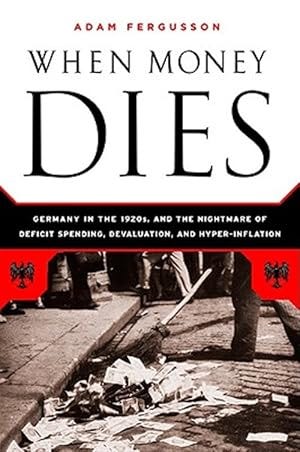
We read this as history. A cautionary tale about a specific country at a specific time. But Ferguson’s deeper insight is universal: the day money dies, no one riots. They just feel confused. The numbers still appear on the bills. The banks still open their doors. But something underneath, some invisible contract, has been quietly breached, and every interaction from that point forward carries a charge of suspicion that wasn’t there the day before.
I’ve been thinking about that basket a lot lately, because I keep seeing its outline in the present.
Luke Gromen, the macro researcher, flagged something recently that got me thinking. For two consecutive months, October and November 2025, the single largest American export was non-monetary gold. Not aircraft. Not semiconductors. Not intellectual property. Gold. Shipped in bulk through Switzerland and onward to China and the Gulf states. A Forbes trade editor confirmed it was the first time this had happened in at least twenty years, and probably ever.

Think about that for a moment. The world’s reserve-currency nation, the country that was supposed to lead the knowledge economy into the twenty-first century, and our biggest contribution to global trade is a metal most economists spent the last fifty years dismissing.
Gromen’s interpretation is blunt: the post-1971 monetary system, in which the debt of a deeply indebted sovereign somehow served as the risk-free foundation for global commerce, is ending. Not threatening to end. The gold flows are the photograph. The anomaly wasn’t gold. The anomaly was the last fifty years.
Louis-Vincent Gave of Gavekal Research arrives at a similar conclusion from a different direction. Writing in mid-February, he catalogued nine market trends that, taken together, describe a regime change in progress. The US dollar has weakened despite every factor that should have supported it: the highest policy rates in the developed world, record-breaking weight in global equity indices, massive AI enthusiasm. Meanwhile, China’s trade surplus, now roughly $100 billion per month, expanded even as the renminbi strengthened against the dollar. This isn’t supposed to happen. It’s happening.
The markets, when you listen to them, are screaming. Gold above $5,000. Bitcoin cut in half from its highs. Crypto losing $2 trillion of capitalization in six months. US knowledge stocks, Salesforce, Accenture, Moody’s, FactSet, down by a third to two-thirds. Japanese government bonds delivering the worst returns of any major sovereign market. Private equity giants posting negative returns for the first time in a generation.
Barton Biggs, in Wealth, War and Wisdom, spent years studying how markets behave at civilizational inflection points. His great finding: prices are often wiser than the people setting them. Markets peaked before World War II began and bottomed before it ended. The collective intelligence of the price system signals regime changes long before newspapers, politicians, or the people living through them are willing to admit what’s happening.
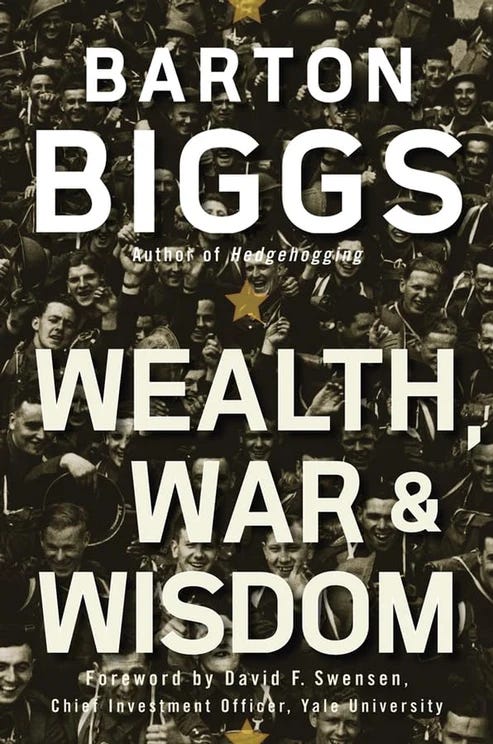
I look at the signals and I hear Biggs: the regime is changing.
Strauss and Howe would place us squarely in what they called a Fourth Turning: the climactic phase of a roughly eighty-year cycle in which the institutional order built by one generation is torn down and rebuilt by the next. The last one was the Depression and World War II. Before that, the Civil War. Before that, the American Revolution. Each time, the monetary and financial order that existed before the crisis did not survive it. Each time, what emerged was not a repair but a reinvention.
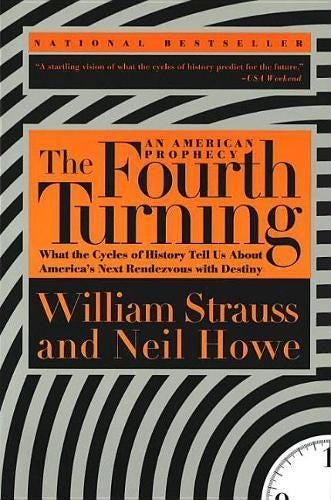
The money is not dying in the Weimar sense. No one is papering their walls with hundred-dollar bills. But the meaning of money is shifting beneath us. The forty-year regime in which financial assets reliably appreciated, bonds were the unquestioned risk-free anchor, and the dollar’s centrality was the gravitational constant of global commerce, that regime is fracturing.
Gromen puts it with characteristic directness: stocks may keep going up in dollar terms while going down in gold terms. You can feel richer while becoming poorer. The numbers on the screen get bigger while the basket on the sidewalk holds less and less. Most of us feel this already.
II. The Four Hour Absence
Now hold that thought, the ground shifting under money, and turn to work.
In early February 2026, a software engineer named Matt Shumer published a letter to his family and friends. He’d been working in AI for six years, and he’d been giving the people he loved the polite version, the cocktail party version, of what was happening. He couldn’t do it anymore. “The gap between what I’ve been saying and what is actually happening,” he wrote, “has gotten far too big.”
Here is what his Monday looked like: He described an application he wanted built. In plain English. Then he left his computer for four hours. When he returned, the AI had written tens of thousands of lines of code, opened the application, tested it by clicking through every feature the way a human would, iterated on the design until it met its own standards, and presented the finished product. It was, he said, usually perfect.
A year earlier, he was guiding the AI, correcting its errors, going back and forth. Now he just describes what he wants and walks away. “I am no longer needed,” he wrote, “for the actual technical work of my job.”
What shook him most was not the competence. It was something that felt, for the first time, like judgment. Like taste. “The inexplicable sense of knowing what the right call is that people always said AI would never have.” Not the technically correct answer. The right one.
METR, an organization that benchmarks AI capability, tracks the length of real world tasks a model can complete end-to-end without human help. A year ago, about ten minutes. Then an hour. Then several hours. The latest measurement: nearly five hours of expert level work. That number is doubling every four to seven months. Extend the curve, and it has held for years, and you’re looking at AI that works independently for days within the next year. Weeks within two.
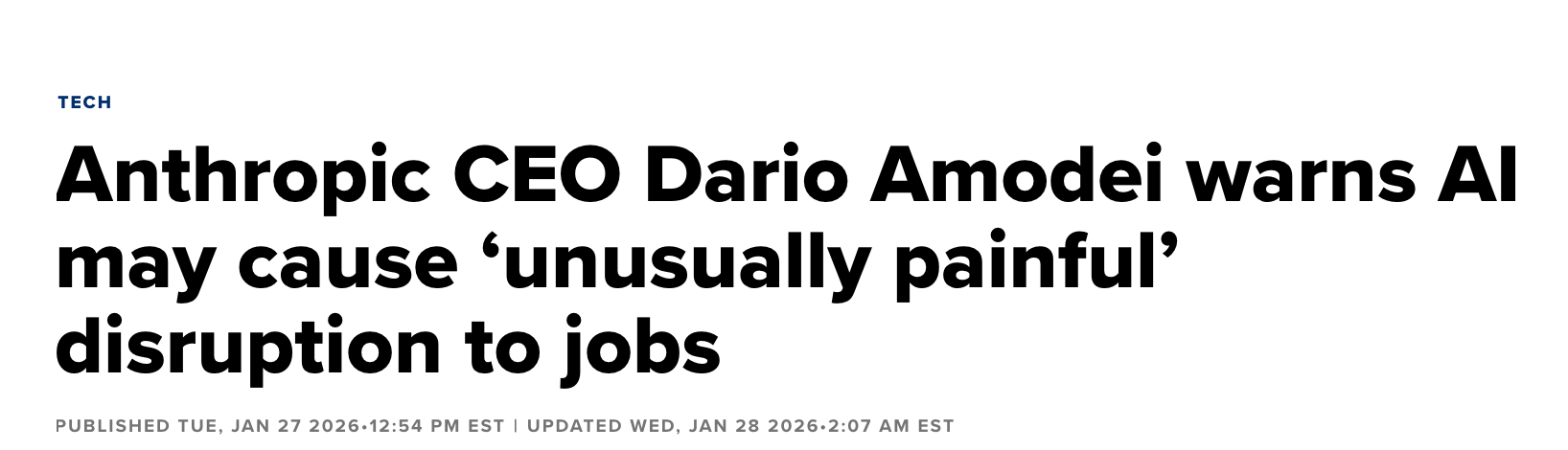
Dario Amodei, the CEO of Anthropic, has publicly predicted that AI will eliminate fifty percent of entry level white collar jobs within one to five years. Many in the industry think he’s being conservative. And this was before the February 5th models that shook Shumer.
Gave’s market data tells the same story from the investor’s side. Knowledge stocks aren’t just underperforming, they’re in free fall. The market has concluded that AI is an existential threat to businesses built on knowing things: consulting firms, data platforms, analytics providers, enterprise software. If knowledge becomes ubiquitous and free, the companies that sell access to it are stranded assets. And so are the careers built on their logic.
Shumer names the thing that makes this different from every previous wave of automation: AI is a general purpose substitute for cognitive work. It improves at everything simultaneously. When factories automated, displaced workers retrained for offices. When the internet disrupted retail, workers moved into logistics. But AI doesn’t leave a convenient gap to flee into. Whatever you retrain for, it’s improving at that too.
Then, buried near the end of his letter, the sentence that stopped me: “Your dreams just got a lot closer.”
III. The Commons Beneath Both
If you read most commentary, these two stories, the unraveling of the monetary order and the automation of knowledge work, are treated as separate phenomena. I think that’s wrong. I think they are the same event.
Adam Butler, in an essay called “The Strip-Mining of Trust,” provides what I believe is the connective tissue. His argument is simple and tough to look away from: trust is a commons. Not a metaphorical commons. An actual shared resource, like clean air or topsoil, that everyone draws on and no one replenishes. It cannot be measured. It cannot be priced. It does not appear on any balance sheet. And for exactly those reasons, markets treat it as an externality, a cost to be minimized, an inefficiency to be eliminated.
Butler opens with the trading pits of the Chicago Board of Trade, where a handshake between two men in colored jackets was the contract. No algorithm, no timestamp, no audit trail. Just the knowledge that they would see each other tomorrow, and the day after, and that a broken word meant a broken career. The system ran on trust, and because it ran on trust, it ran almost for free.
The pits are gone now. The handshakes have been replaced by matching engines executing trades in microseconds. More efficient. More legible. More profitable, at least in the quarterly reports. But the algorithms inherited a reservoir of institutional trust built over a century, the sediment of ten thousand handshakes honored, and they cannot replenish a drop of it. In the space where trust once operated for free, a vast new industry emerged: lawyers to draft the contracts the handshake didn’t need, compliance officers to monitor behavior that reputation once constrained, surveillance systems to verify settlements that memory once guaranteed.
Here is Butler’s acid observation: the destruction of trust is not merely a cost. It is a profit center. GDP doesn’t count the handshake. GDP counts the lawyer. A high-trust society looks poorer by our metrics than a low-trust society frantically purchasing substitutes for what it has lost. We have, he writes, “defined wealth in terms that reward its destruction.”
Read that again, and then think about what’s happening to money.
The monetary system was built on trust, trust that the United States would manage the dollar responsibly, that sovereign bonds were risk-free, that the financial plumbing was sound. Decades of deficit spending, financial engineering, and geopolitical weaponization of the dollar drew down those reserves. The trust wasn’t naivety. It was the rational response to a system that had earned it. And it was precisely this earned trust that made the extraction possible.
Now think about what’s happening to jobs.
The employment structure was built on a parallel trust, trust that expertise had enduring value, that credentials signaled competence, that institutions would invest in people as people invested in them.
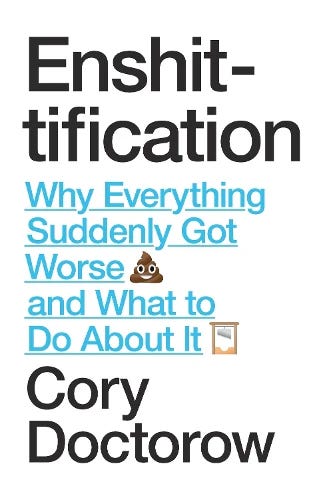
Cory Doctorow’s concept of enshittification names the terminal phase: platforms that attracted users with genuine value, then degraded that value to extract profits, then degraded the experience further until nothing remained but a husk wearing the skin of something that used to work. It’s not just platforms. It’s careers. It’s industries. It’s the implicit social contract that if you got educated, showed up, and did good work, you’d have a place.
Both pillars, money and work, are failing for the same reason. The commons of trust on which they depended has been strip-mined. And the strip-mining registered, every step of the way, as economic growth.
Butler tells the story of Gloria Reyes, a cardiac nurse with twenty-three years of experience, whose hospital’s productivity software flags her as non-compliant because she spent time sitting with a frightened patient. Three shifts earlier, during moments the algorithm would classify as idle time, she had built enough trust with that patient that he finally admitted his chest felt different. She paged cardiology. The cath lab found a 94% occlusion in his left anterior descending artery, the widow-maker. He went home to his family in eight days.
The ledger for that shift shows one efficiency violation.
The ledger cannot show the three shifts of trust-building that made the disclosure possible. It cannot show twenty three years of pattern recognition that heard the word “different” and understood danger. It cannot show the social capital that transforms a terrified man’s silence into lifesaving speech.
The algorithm sees waste. The man’s family sees him at breakfast.
IV. The Friction That Makes Us Human
Now I need to take you somewhere you might not expect, because I believe the most important thing happening in this phase change is not financial and not technological. It’s philosophical. And it has to do with what consciousness actually is.
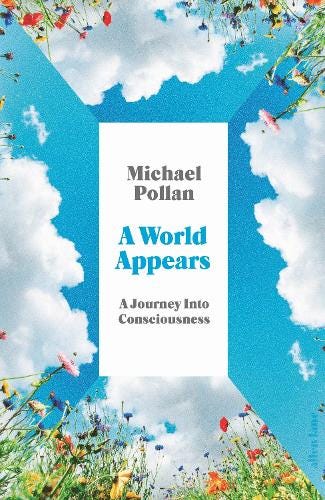
Michael Pollan, in his new book A World Appears, makes an argument that has been quietly detonating in my mind since I encountered it. Pollan is persuaded by neuroscientists Antonio Damasio and Mark Solms, who have built a case, grounded in clinical evidence, not speculation, that consciousness does not originate in the cortex, the seat of computation, reasoning, analysis, all the things AI excels at. It originates in the brain stem. In feelings.
Feelings, they argue, are the language the body uses to get the brain’s attention. Hunger. Fatigue. The subtle wrongness when something is off. The warmth of being held. Consciousness doesn’t arise from thinking. It arises from feeling a body in a world.
People with damaged or absent cortexes can still be conscious. But damage certain structures at the top of the brain stem and consciousness vanishes entirely. The most sophisticated reasoning apparatus in the known universe , the human cortex appears to be a tool of consciousness, not its source.
Consciousness comes from below. From the body. From feeling.
If this is true, then the implications for the AI revolution are profound. Because what feelings require is embodiment. A nervous system that monitors blood gases and heart rate and hunger and fatigue and the thousand signals that constitute being alive in a physical body interacting with a physical environment. AI has none of this. “Everything that machines know,” Pollan observes, “is information, most of it on the internet. They don’t have friction with nature. They don’t have friction with the world, with us, that real contact that depends on embodiment.”
Friction.
Notice how that word keeps appearing in this essay, wearing different clothes each time. Butler uses it to describe the cost of lost trust, the lawyers, the compliance systems, the surveillance. When trust is present, friction vanishes. When trust is absent, friction becomes an industry.
But Pollan uses the same word to describe something entirely different: not a cost to be minimized but the substance of conscious experience itself. The resistance of material reality against our bodies. The catch in someone’s voice that tells you they’re frightened. The weight of a child sleeping against your chest. The cold that wakes you up.
This friction is not an inefficiency to be optimized away. It is what it feels like to be alive.
And this is the thing no algorithm can have. Not because the engineering isn’t there yet. Because consciousness, if Damasio and Solms and Pollan are right, is not a computational achievement. It is a biological one. It requires a body that can suffer, that can hunger, that can feel the specific ache of missing someone. The machine can process every text ever written about grief. It cannot grieve.
Here is the paradox at the heart of the phase change, and I think it’s the most important thing in this essay: the same technology that is destroying jobs built on knowledge work is simultaneously revealing that the most valuable human capacities were never cognitive at all. They were always embodied. Relational. Emotional. They were Gloria Reyes hearing the word “different” and knowing. They were the things we couldn’t put on a résumé because we couldn’t reduce them to information. They were the things the productivity dashboards recorded as waste.
Pollan calls this moment Copernican, a redefinition of what it means to be human. The fear is that AI will prove we were never special, that consciousness was always just computation and the machine can do it better. But the evidence points the other way. The more spectacularly capable AI becomes at every cognitive task, the more clearly it illuminates the one thing it cannot do: feel.
Pollan also observes something I find beautiful: that some of the highest experiences of human life are moments when consciousness expands beyond the boundaries of the self. The dissolution of ego in meditation, in psychedelic experience, in flow, in love, in that moment when you are so completely absorbed in music that the boundary between listener and sound disappears. He describes merging with a Bach cello suite so completely that “the subject-object split went away, and I was identical to this piece of music.”
These moments are not cognitive achievements. They are not the product of better data or sharper analysis. They are available only to beings who have a self to transcend, which is to say, beings with bodies, with feelings, with the long accumulated friction of a life in the world.
AI cannot transcend itself. It has no self to lose.
V. The Controlled Burn
Strauss and Howe predicted that the Fourth Turning would be characterized not by a single dramatic event but by a cascading loss of faith in institutional authority: financial, intellectual, cultural, professional. The structures that told people who they were and what they were worth would lose their power to convince.
That prediction has been fulfilled with a thoroughness that might have startled even them.
The monetary authorities who promised stability presided over the greatest wealth transfer in history. The tech platforms that promised connection delivered surveillance and loneliness. The knowledge economy that promised meaningful careers delivered credentials that AI can replicate in seconds. And now, as Pollan warns, even our attention, the substance of consciousness itself, is being colonized. “Our consciousness,” he says, “is being polluted.” Algorithms optimized for engagement are, in practice, optimised for outrage, which means optimised for the precise opposite of the clear, careful awareness that a conscious life requires.
Butler’s framework names this for what it is: one more commons being strip-mined. Attention is trust’s first cousin. It is the substrate of care, of relationship, of every form of cooperation. When it is harvested for profit, chopped into fragments, sold to advertisers, redirected toward content designed to provoke rather than illuminate, the extraction is no less real than the extraction of financial trust or institutional credibility. The friction industry has come for the mind.
But Fourth Turnings end. That is the other half of Strauss and Howe’s framework, and the half that people in the midst of crisis find hardest to believe. The destruction of the old order is not pointless. It is a controlled burn. The generation that comes of age in the fire doesn’t merely rebuild what was lost. They build something that could not have existed before the clearing.
The Depression and World War II destroyed the gold standard, the colonial empires, the old European order. What emerged was Bretton Woods, the Marshall Plan, the United Nations, the greatest expansion of the middle class in history. Not because the crisis was good. Because it made it impossible to keep pretending the old arrangements worked.
Butler makes the same point about trust: we have bound markets before. Child labor was efficient. We outlawed it. Pollution was profitable. We regulated it. The strip-mining of trust will be bound too, not because we’re optimists, but because the alternative is a society that cannot function, and such societies do not accept their fate quietly.
VI. What Emerges
I want to be careful here, because the temptation at moments like this is either despair or utopianism. The honest answer is that no one knows exactly what’s coming. But the shape of it is already visible through the steam, the way you can see the new landscape forming even as the phase change completes.
Money is becoming honest. The fifty year experiment in faith-based currency, money backed by nothing but the borrowing capacity of governments that cannot stop borrowing, is giving way to something that acknowledges physical reality. Gold flows are the most visible symptom, but the deeper shift is philosophical: a return to the idea that the unit of account should be something that can’t be conjured at will by people who face no consequences for conjuring it. Gromen’s data is not a prediction. It’s a photograph of a system already reorganizing itself. Painful, yes, especially for those whose wealth is denominated in the old regime’s instruments. But also a return to something more real.
Work is becoming embodied. For decades, the knowledge economy generated an enormous class of workers whose jobs consisted largely of mediating information, formatting it, summarising it, transmitting it, gatekeeping it. Many of these were, at bottom, friction jobs: they existed because information was expensive and hard to move. AI is eliminating the friction. Devastating for those whose livelihoods depend on it. But it also means the things humans do that are not friction, the things that require presence, care, physical skill, relational trust, the things that arise from having a body in a world, are becoming, for the first time in a generation, the economy’s most irreplaceable contributions. The cognitive got commoditized. The conscious cannot be.
Consciousness is becoming the essential currency. Not in a mystical sense. In the most hardheaded sense I can articulate. If consciousness is grounded in embodiment, then it is the one resource that cannot be replicated, automated, or extracted. You can strip-mine trust. You can debase money. You can automate knowledge work. But you cannot automate the experience of being aware, of choosing to pay attention to this rather than that, of sitting with someone in their suffering and creating through your sheer presence the conditions under which they can speak. Pollan observes that consciousness has become our secular substitute for the soul. “We talk about consciousness the way people in the seventeenth century talked about souls.” I think he’s more right than he knows. In a world where institutions have lost their authority, money has lost its anchor, and credentials have lost their value, the irreducible thing, the thing that can’t be taken, debased, or faked, is your capacity for awareness. Your ability to feel. Your willingness to be present with another person in a world that presses back against you.
Trust is being rebuilt. Not by institutions, they’ve forfeited that privilege, but from the ground up, person by person, the way it has always actually been built: through repeated interactions, kept promises, and the slow accumulation of a shared history. The generation inheriting the rubble will build new structures worthy of trust, because they must. They have no other choice. They’ve seen what extraction looks like and they know the bill.
VII. What You Bring Through
You cannot stop the ice from melting. You can choose what you carry through the steam.
Biggs studied what happened to wealth during the great upheavals of the twentieth century and found that the survivors were not the best predictors. They were the most adaptable, diversified across asset classes, geographies, and types of value, and psychologically flexible enough to let go of what the old regime told them was permanent. The destroyed were the ones who were all in on a world that no longer existed and couldn’t release their grip.
Gromen’s practical advice runs parallel: a portfolio modeled on Jacob Fugger, the Renaissance merchant who rode out dynastic wars and monetary upheavals as the richest man of his era: a quarter gold, a quarter cash, a quarter equities, a quarter real estate, rebalanced regularly. Not to pick the winner. To survive the tail risks that destroy everything. In a phase change, the point is to be standing on the other side.
But this essay isn’t about portfolio construction. It’s about the question at the center of everything the Curious Mind tries to explore: what is human potential, and what unlocks it?
And here I think the phase change, for all its violence, is delivering an answer that the old regime never could have.
For most of history, the vast majority of people never got to find out what they were capable of. They were too busy surviving. Then, for a few decades, the knowledge economy created a middle class with some leisure and education, but channeled it almost entirely into institutional service. You could be anything, as long as anything meant a professional role within an existing structure. Your potential was defined by your position on someone else’s organizational chart.
Now the tools of creation are becoming free. The barriers to building are collapsing. What AI takes away, routine cognitive work, the mediation of information, the gatekeeping of knowledge, it simultaneously gives: the ability to build things that would have required teams, to learn things that would have required tuition, to reach people that would have required institutions. Shumer: “If you’ve ever wanted to build something but didn’t have the technical skills, that barrier is largely gone.”
So here is what I’d say to anyone reading this who feels the ground shifting.
Protect your consciousness. Pollan is right that we need consciousness hygiene, and we need it now. The algorithms competing for your attention are strip-mining your awareness with the same logic that financialization used on trust. Your attention is not a resource to be harvested. It is the ground of your freedom, your creativity, your capacity to care. Guard it like savings in an era of debasement.
Invest in your body. If consciousness is embodied, if the irreducible human advantage is our capacity for feeling, for presence, for the kind of knowing that arises from having a body in a world, then your body is your most important asset. Not your credentials. Not your network. The physical, mortal, feeling thing that can walk into a room and sense the unspoken, that can hold a child, that can hear the word “different” in a patient’s voice and understand danger. Bring it into contact with the world. Not the screen. The world. Soil, weather, effort, other bodies, the friction machines cannot have.
Build something you care about. Not optimising for a career path that may not exist by the time you arrive. Not credentialing for a system that’s dissolving. Building. Creating. Pursuing the thing that pulls you forward even when no one is watching and no algorithm is tracking your efficiency. The phase change is going to destroy much of what felt permanent. But the capacity to care about something enough to build it, to endure the difficulty, the failure, the long unromantic middle of making something real, that’s the one human capacity that neither markets nor machines can replicate.
Shumer tells his friends: spend one hour a day experimenting with AI. Using it, not reading about it. Try to get it to do something you haven’t tried before. If you do this for six months, you’ll understand what’s coming better than almost everyone around you.
I’d only add: use that hour to build the thing you’ve been putting off. The project, the business, the book, the craft, the community. The tools are there. The knowledge is free. The only scarce input left is the one that was always the scarcest: the will to make something, grounded in the full, feeling, embodied experience of a person who gives a damn.
VIII. Through the Steam
The phase change will not be gentle. It is going to destroy financial instruments people believed were permanent stores of value. It is going to eliminate job categories people believed were safe. It is going to hollow out institutions people trusted. And it will do all of this faster than preparation feels possible.
But here is what it will also do: it will strip away decades of accumulated pretense about where human value actually resides.
It does not reside in the ability to process information. Machines do that better.
It does not reside in credentials, networks, or institutional affiliations. Those were claims on a system that is repricing.
It resides in the capacity to feel. To care. To create. To be present with another person in their need. To imagine something that doesn’t exist and endure the friction of bringing it into the world. To sit with a dying man and listen to him talk about his wife’s roses, the ones she planted in 1987, the year their son was born, because somewhere, in the only commons that cannot be enclosed, that memory still matters.
The nurse who silences her tablet to be present with a grieving stranger is not committing a productivity violation. She is performing the most essential act in the economy, the one no balance sheet captures, the one no algorithm can replicate, the one that keeps the entire human project from collapsing into optimization without purpose.
Pollan says some of the most profound moments of his life have been experiences of self-transcendence, when the ego dissolved and he felt connected to something immeasurably larger. He once lost himself so completely in a Bach cello suite that the boundary between listener and music simply disappeared. That experience, he notes, was only possible because he had a self to lose. The machine processes the waveform. It cannot vanish into the music.
This is what survives the phase change. Not the resume, not the portfolio, not the job title. The irreducible thing: a conscious being, in a body, in a world, choosing to pay attention.
The ice is melting. The steam is rising. The old forms are losing their shape.
And somewhere in the clearing, the people who refused to be optimised are already building what comes next.
If this resonated, share it with someone who feels the ground shifting. They’re not imagining it.
If you enjoy reading The Curious Mind, please do me the huge favour of simply pressing the like button. It costs you nothing, means the world to me, and makes the algorithm work for us.
TCM, this is a beautifully constructed essay, and I find the Pollan/Damasio/Solms argument that consciousness is embodied genuinely compelling. I'd like to add a dimension I think complements your thesis.
The question that may prove most consequential is not whether AI is conscious but whether people perceive it as conscious. And the evidence already indicates that they do. Research consistently shows people ascribe consciousness to AI based on conversational fluency and humanlike behavior—often implicitly, without realizing they're doing it.
When people perceive AI as having agency, they trust it more and form emotional bonds with it. Intense bonds in some cases – witness the uproar over OpenAI’s retiring of ChatGPT 4. People increasingly treat AI as if it has interiority. As Naval said recently, “AI is the great automator, and to automate, it must first imitate. The imitation fools people into thinking it’s alive.”
Your essay draws an elegant line—AI handles the cognitive, humans retain the embodied and relational. I think that's directionally right. But it's worth considering what happens if people experience AI as empathic and present, even though it’s projection. The nurse sitting with a frightened patient is irreplaceable—but only so long as patients and institutions recognize she is. Many already consider AIs more empathic than most people.
This element of the phase change may ultimately be as much about what happens when the attribution of consciousness becomes untethered from its biological source as it is about consciousness itself.
piece of art, store it and re-work it again in a few months !